30 May 2026 · 2 min read
Dressing a deity: designing a shringar that thousands will see in a day
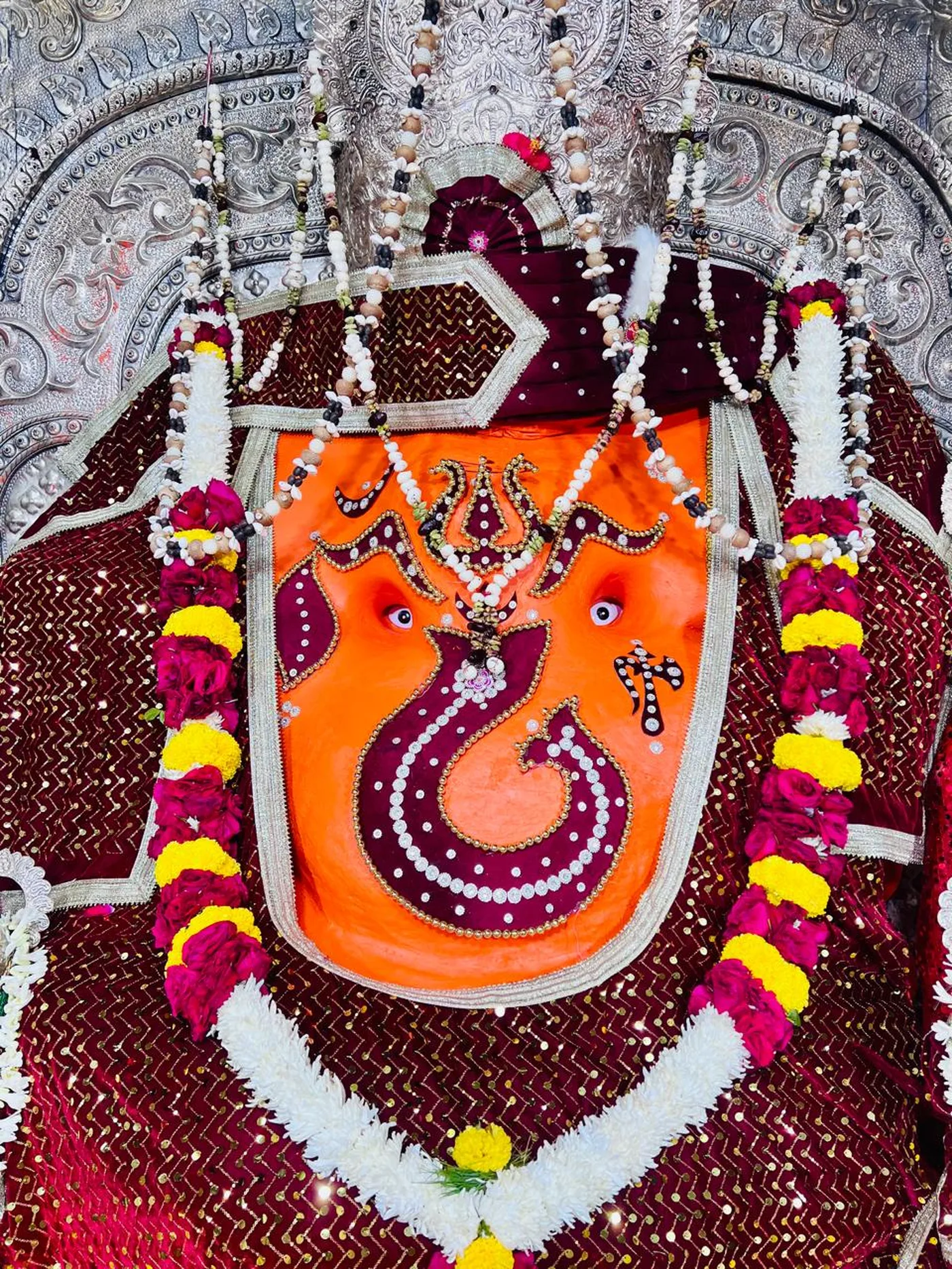
At Khajrana, the audience is not a gallery. It is a queue that does not stop — and the work has to be legible from twenty feet, in lamplight, to someone moving past.
Most art is made for a viewer who is standing still. Shringar is not. It is made for someone shuffling forward in a queue, catching sight of the deity for a few seconds, in light that comes mostly from lamps.
Every design decision follows from that.
Scale before detail
The instinct is to work fine — to add small, careful ornament that rewards close attention. At Khajrana Ganesh Mandir, almost nobody gets close attention. The composition has to resolve at a distance first.
So the large shapes get decided before anything else: where the mass of colour sits, where the eye lands, what silhouette the whole reads as from the back of the hall. Fine work is added afterwards, and only where someone at the rail might actually see it.
Getting this backwards produces a shringar that photographs beautifully and disappears in the room.
Colour under lamplight
Lamplight is warm and uneven, and it eats certain colours. Cool blues go muddy. Pale pinks vanish against skin tones. Deep maroon, saffron and gold hold up, which is why traditional palettes look the way they do — they were solved centuries ago by people working in exactly this light.
There is room to move within that, but not much. Choosing a fashionable palette that fails at dusk is not a bold choice, just an unusable one.
Working around the flowers
Fresh garlands are not an afterthought laid on at the end. They are part of the composition, and they occupy real space — often the space you most wanted for fabric work.
So the fabric is designed around where the flowers will fall. That means accepting that a section of your careful beadwork will be covered, and placing it there anyway, because the balance depends on it existing underneath.
Assembled in place, against the clock
A shringar cannot be built in a studio and installed. It is assembled at the altar, in the hours before darshan, working around fixed architecture and a schedule that does not move.
There is no version of this where you step back the next morning and adjust. What is there at opening is what thousands of people will see.
Made to be dismantled
And then it comes down.
That is the part people find hardest to accept — that something this considered lasts a day. But impermanence is not a flaw in the form, it is the form. The work exists inside a ritual rather than on a wall, and rituals repeat. Next time it will be different, which is the only reason it stays interesting to make.